Identification
Essential Oil of Holy Basil
(Ocimum gratissimum L)
Origin: VietNam
Processing method: Steam distillation of the leaves and flowering tops.
EINECS-CAS: 91770-38-6
EC: 294-822-9
Specification
Specific Gravity at 20oC: 1.030-1.050
Refractive Index at 20oC: 1,530 – 1.540
Optical Rotation at 20oC: -15.6 0 – 20.2 0
Odour: Powerful, warm-spicy and aromatic
odour
Appearance: Brownish-yellow to pale yellow
liquid
Flashpoint: >90oC (closed cup)
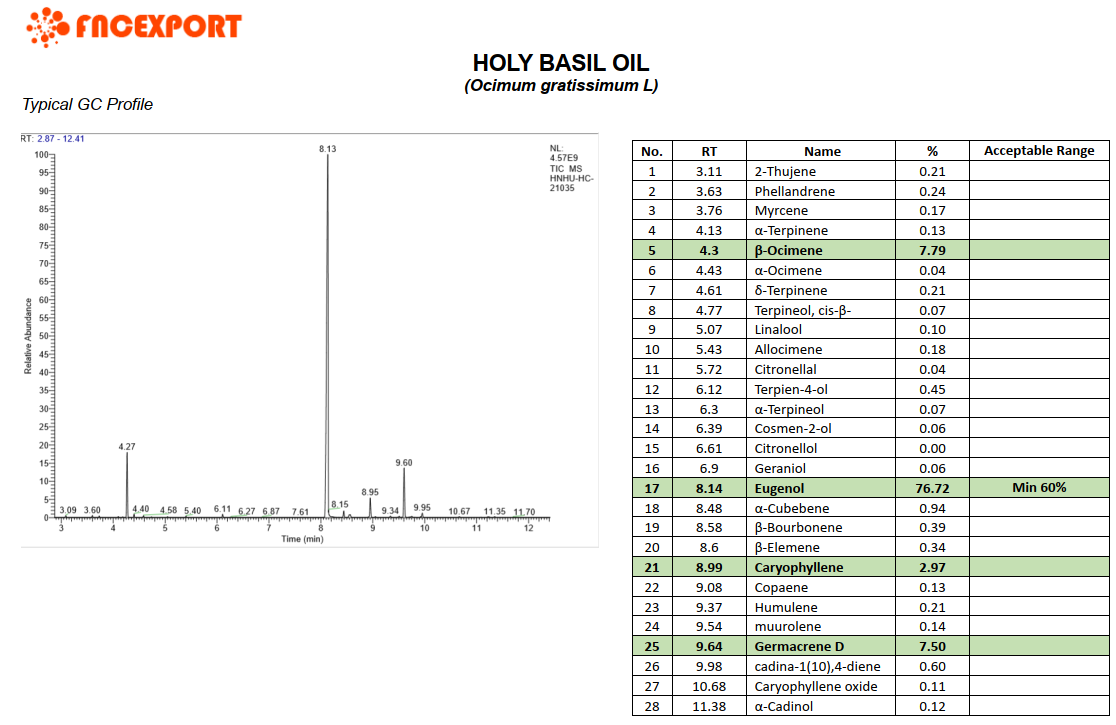
Main component:
Eugenol: min60% with small amount of
(Z)-beta -ocimene;D- germacrene ; E-
Caryophyllene.
Plant material and cultivation details
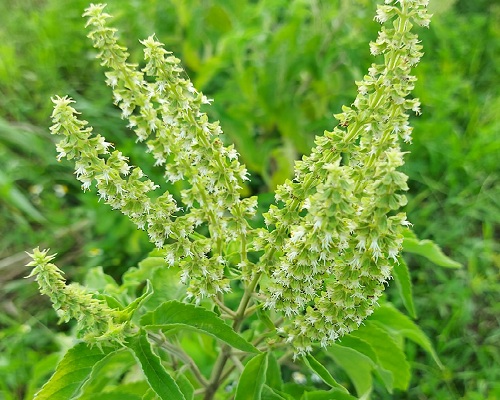
Holy Basil (Ocimum gratissimum L.) belongs to the family Lamiaceae. It grows up to a height of 1-3 m, leaves have opposite phyllotaxy and petiole is 2-4.5 cm long, slender and pubescent. This plant consists of verticillaster inflorescence consisting of purple to pink colored flowers. Flowers are arranged in a terminal, simple or branched raceme 5-30 cm long, bracts sessile, ovate, 3-12 mm x 1-7 mm, acuminate, caducous; pedicel 1-4 mm long, spreading or ascending, slightly curved.
Holy Basil is propagated by seed or cuttings. In VietNam, the time for transplanting seedlings into the field from May-August. Plants are spaced at about 40 cm × 50 cm. The optimum harvesting time for distillation of the essential oil is when 3 branches per plant or 75% of the branches are flowering.
Depending on the climatic conditions, 2 – 4 cuts can be obtained per year. On average 1 hectare of Holy Basil in high density (1.5 m2 / cluster), it can provide 12-15 tons of branches and leaves once to harvest, yielding 48-60 kg essential oil (0.4- 0.5%).
Holy Basil remains productive for 5-10 years. After harvesting the aboveground parts, the plants are left to wilt in the shade for a few days and are then steam-distilled to extract the essential oil.
Traditional Uses
The warm, sweet aroma of Holy Basil Essential Oil lends well for creating energizing, help enhance focus while easing anxiety and stress.
Holy basil is an aromatic, stimulant, antispasmodic, antiseptic herb that repels insects, expels internal parasites and lowers fevers.
The leaves and stems are used internally in the treatment of colds, especially chest colds; fevers, headaches, impotence, flatulence, diarrhoea, dysentery, post-partum problems, and worms in children.
Applied externally, the leaves are used to treat rheumatism and lumbago.
GC test report