Identification

Essential Oil of Cajeput
(Melaleuca cajeputi)

Origin: VietNam
Processing method: Steam distillation of the leaves and terminal branchlets.
CAS number: 8008-98-8
EC: 287-316-4

Specification

Odour: Fresh, camphorous aroma with a slight fruity scent.

Appearance: Colorless to pale yellow clear liquid

Relative density (20°C): 0.868 to 0.925

Refractive index (20°C): 1,466 – 1,472

Optical rotation (20°C): -4 to +2

Flash point: 57°C (closed cup)

1.8-Cineole: 52% to 65%

Alpha-Terpineol: 9% to 16%

Limonene: 2% to 7%

Linalool: 2% to 4.5%
Myrcene: 0.7% to 3%

Plant material and cultivation details

Cajeput (Melaleuca cajeputi) is an evergreen tree with erect trunk, may exceed the 30 m of height and 1 m of diameter, with soft and spongy white-greyish bark flaking off in long thin laminae. The leaves 5-12 cm long and 1,2-3 cm broad, rigid, dark green colour. The inflorescences are axillar and cylindrical terminal spikes, 4-10 cm long, with pubescent rachis and white, greenish white or cream colour.

In VietNam, the Cajeput tree grows abundantly. The leafy branches are machete-cut during the dry season from November to April and distilled fresh. Harvesting can be done throughout the year, but this period ensures the best essential-oil yields.

Traditional Uses

As an aromatherapy agent, Cajeput oil stimulates the mind and promotes clear thinking, helps to dispel mental fatigue and apathy. It is used as a fragrance and freshening agent in soaps, balms, cosmetics, detergents and perfumes.

Cajeput essential oil is a common household medicine in VietNam, used internally for the treatment of coughs and colds, against stomach cramps, colic and asthma. It is used externally for the relief of neuralgia and rheumatism, often in the form of ointments and liniments, and for the relief of toothache and earache.

The oil is also reputed to have insect-repellent properties, it is widely used for minor conditions such as insect bites and spots.

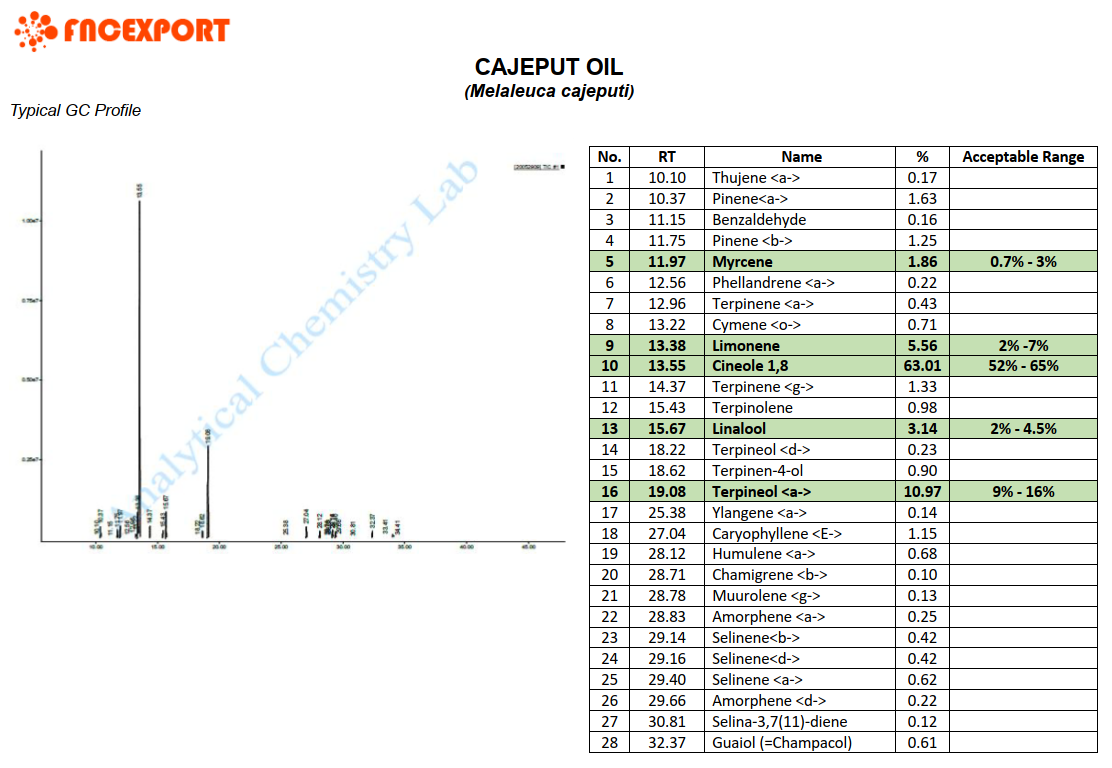
GC test report

gc test